
How to Locate a Buried Septic Tank
Track your septic tank by following the house sewer line, checking records, and probing the yard safely. Learn typical tank placement, lid styles, and depth ranges.
I have lived in my 1970s fixer-upper long enough to know this truth: the day you actually need the septic tank lid is the same day you cannot find it. Grass grows, flower beds migrate, patios get poured, and suddenly that “I will remember where it is” memory turns into an afternoon of stomping around the yard like you are looking for a lost contact lens.
The good news is that septic tanks are not placed randomly. If you work from the house outward, you can usually narrow it down quickly, confirm it with records, and then use a simple probe to find the lid without turning your lawn into a trench.
Before you start: safety and what not to do
Locating a buried tank is a “slow and careful wins the day” job. The goal is to find the lid with minimal digging, not to excavate the whole tank.
Safety first Call your local utility locating service before probing or digging. Gas, electric, communications, and even private lines can be in the same yard where your septic system lives.
- Do not enter a septic tank or lean over an open access port. Dangerous gases and oxygen depletion can overcome you quickly.
- Do not drive a probe aggressively. You are feeling for changes, not spearing the earth.
- Do not dig with a machine unless you are 100 percent certain where the tank, line, and utilities are.
- Do not assume the lid is centered on the tank. Many tanks have lids over the inlet and outlet areas, not the middle.
- Do not stand on a lid you have not fully inspected. Cracked concrete, rotten steel, and deteriorated covers can be a fall-through hazard. Keep kids and pets away from any exposed opening.
Tools that make this easier
You can do a lot with a shovel and patience, but a couple of basic tools speed things up.
- Measuring tape (at least 50 ft)
- Garden trowel or small hand shovel for careful uncovering
- Soil probe (also called a septic probe or tile probe), ideally 3/8 to 1/2 inch diameter with a rounded tip
- Work gloves and eye protection
- Flags or marking paint to note probe hits and measured distances

Step 1: Find where the plumbing leaves the house
Your best starting point is the main building sewer line where it exits the foundation. The septic tank is downstream from that point.
How to locate the exit point
- Basement homes: Look for the main drain stack (the big vertical pipe). Follow it to where it turns horizontal and exits through the wall.
- Crawlspace: Find the main drain line under the floor and follow it to the outside wall.
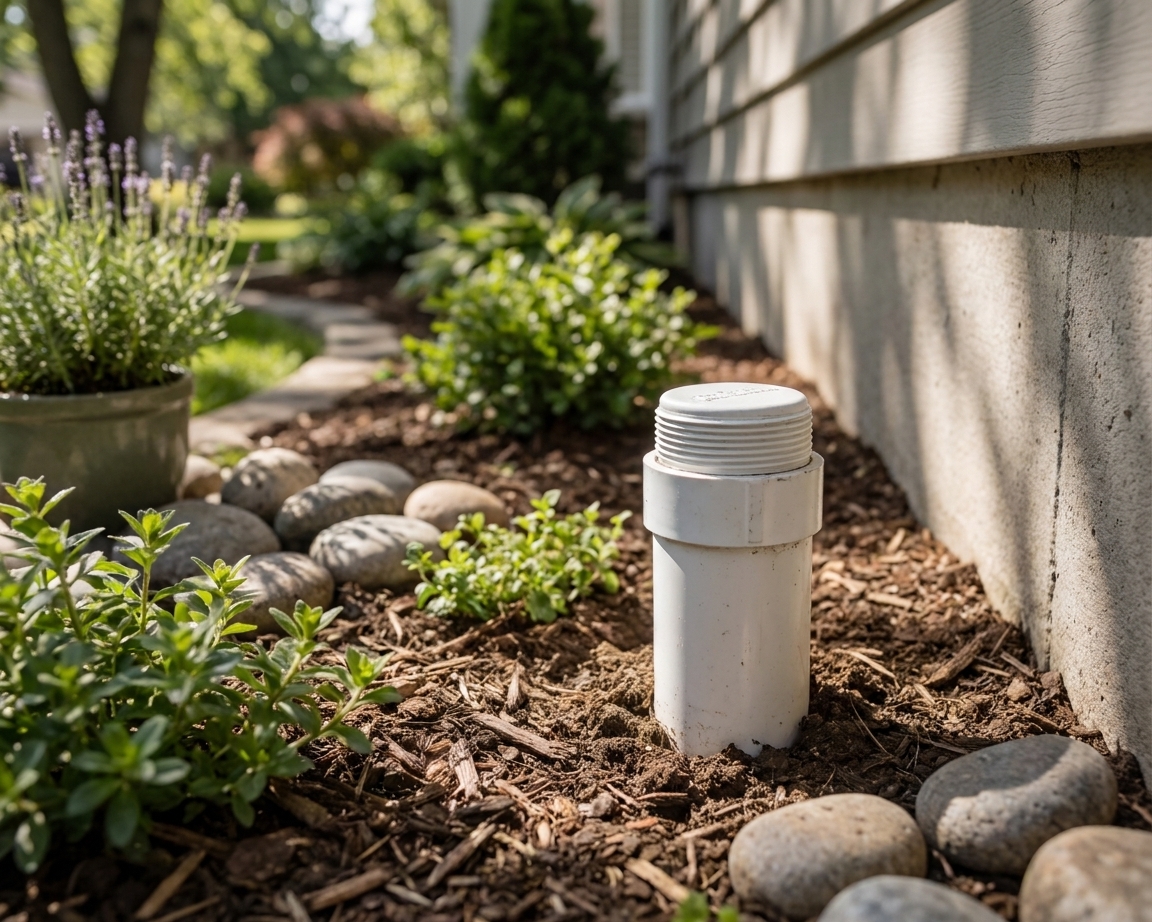
- Slab-on-grade: Check outside for a cleanout near the foundation. If you have a plumbing cleanout in the yard, that can also hint at the line direction.
Once you find the exit location, note which wall it leaves from and the direction it heads. Often the tank is in a fairly straight line from that exit point, but small offsets are common when installers have to dodge trees, boulders, utilities, or a slope.
Step 2: Use records and yard clues
Before you probe a single inch of soil, try to shrink the search area.
Records to check
- As-built drawings from the installer, if you have them in closing paperwork.
- County or health department records for septic permits and site plans. Many jurisdictions keep a sketch that shows the tank and drain field layout.
- Previous owner notes or receipts from pumping or repairs, which sometimes include a hand-drawn map.
Yard clues that often point to a tank
- A slightly raised or slightly sunken rectangular area
- Grass that stays greener in a dry spell (not always, but it is a hint)
- A straight “line” of settled soil that could trace the pipe route
- Unexplained gravel patches or old stepping stones
- Two access lids in line with each other (older tanks sometimes have separate inlet and outlet lids)
If your yard has a patio, deck, or addition, keep in mind tanks sometimes end up buried under later projects. Records become extra valuable in that situation.
Step 3: Estimate distance and depth
Septic tanks are usually placed close enough for maintenance access, but far enough from the home for safety and code clearances. Exact placement varies a lot by lot size, setbacks, terrain, soil conditions, and local rules.
How far from the house to start
A common starting zone is roughly 10 to 25 feet out from the foundation, measured from where the sewer line exits the house. In many yards, starting around 15 feet and working outward in a grid is a solid plan.
On larger or trickier sites, a tank can be farther out. Finding one 30 to 50 feet from the house can happen, especially where setbacks, slopes, or site layout push the system away from the foundation. If you have records, trust the records over rules of thumb.
How deep the lid might be
- Sometimes near the surface: If your system has risers, the lids can be at grade or just barely covered by sod.
- Common for buried lids: about 6 to 24 inches below grade.
- Can be deeper: 24 to 36 inches if the yard has been regraded, if frost depth is a factor, or if the tank was installed deeper for slope reasons.
- Less common, but possible: deeper than 3 feet. At that point, probing is harder and accurate records or a pro locator can save a lot of time.
If you keep hitting something at 2 to 4 inches everywhere, you might be dealing with rocks, old concrete, or construction debris. Slow down and confirm with careful hand digging before you assume it is the lid.
Step 4: Probe carefully
Probing is the fastest way to confirm where the lid is without trenching your lawn. You are feeling for a flat, solid surface that repeats in a predictable shape.
Where to probe first
- Stand at the sewer exit point at the foundation.
- Pick the most likely direction the line runs (based on records, cleanouts, and yard layout).
- Measure out 10 feet and start probing in a line away from the house.
- If you get no convincing solid hits, continue to 15 feet, then 20 feet, and so on.
A probing pattern that works
When you reach a distance where you suspect the tank might be, switch to a grid. Probe every 12 to 18 inches in a rectangle that is roughly 8 by 12 feet. That is a practical starting size, about the footprint area many residential tanks fall within, but it is not a rule. If you are not getting consistent hits, expand the grid a few feet in the direction the sewer line seems to run.
A septic lid hit feels different from a rock. Rocks are often irregular and you can “slip” off the edge. A lid or tank top tends to feel broad and flat, and you will get that same flat feel again a foot over.

What lids look like
Once you are in the right neighborhood, knowing the common lid styles helps you confirm what you found.
Common shapes and materials
- Concrete lids: Often rectangular or square, heavy, and sometimes have a metal lifting ring. Older tanks frequently use concrete lids.
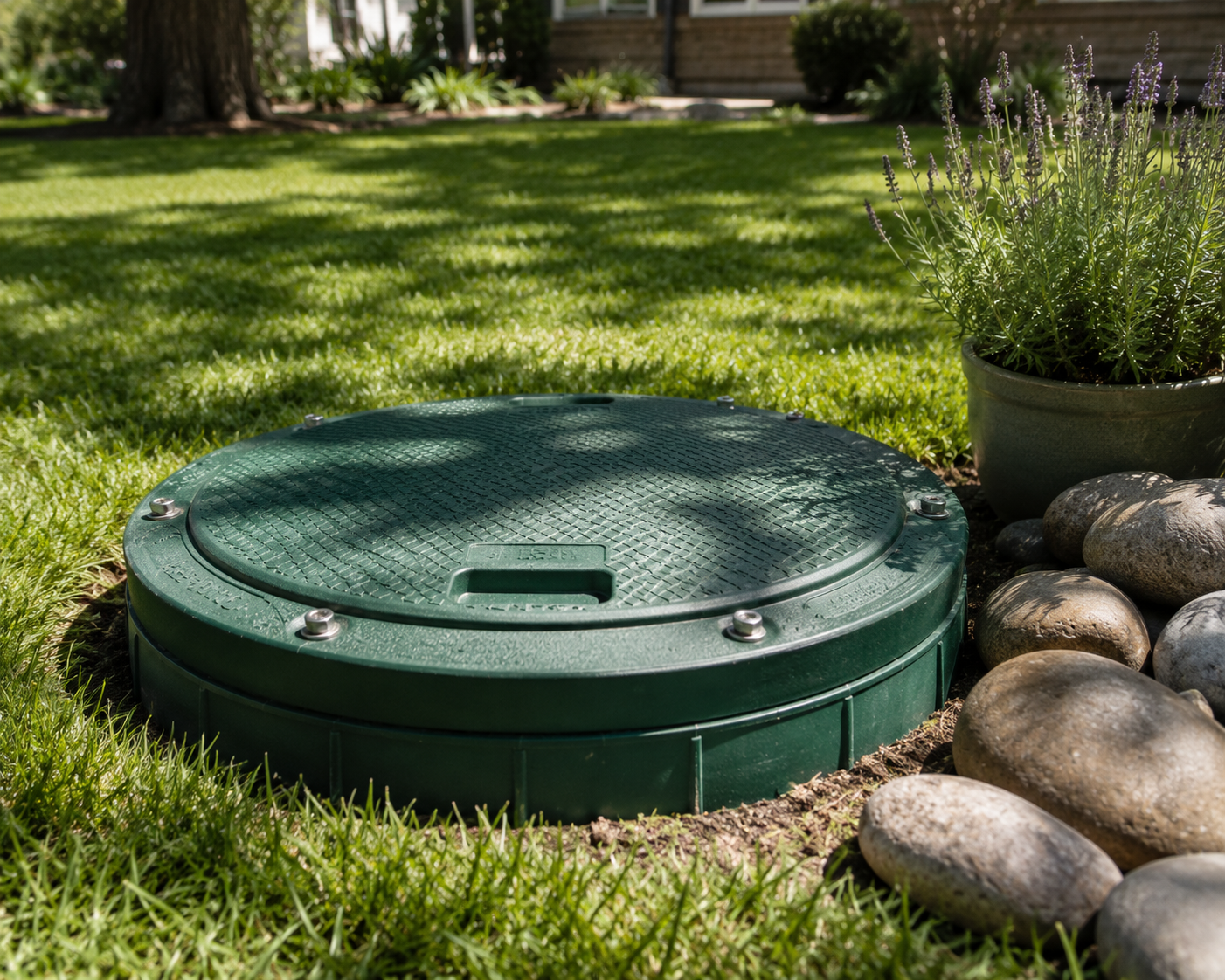
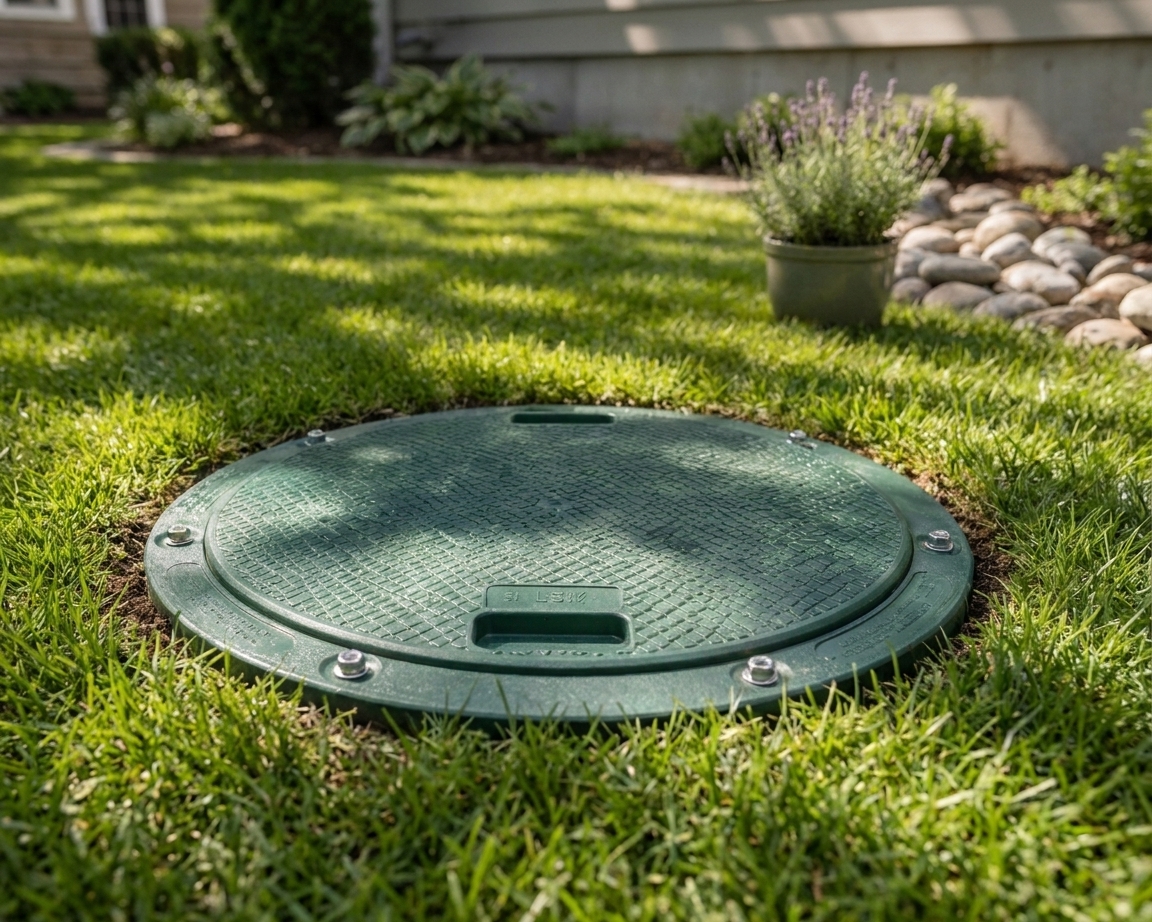
- Plastic riser lids: Round, usually 12 to 24 inches across, sometimes green or black. These are common when a riser has been added to bring access closer to the surface.
- Steel lids: Less common today, found on some older systems. They can corrode and may be unsafe if badly rusted.
Many tanks have two lids, one near the inlet side (from the house) and one near the outlet side (to the drain field). If you find one, there is a good chance another is a few feet away in the same general line.
Confirm before you uncover
When you think you have the lid location, do a quick sanity check before digging.
- Does it make sense with the house line direction? The tank should be downstream from that exit point, even if it is slightly offset.
- Does the shape repeat? Probe around the hit. A lid area will give consistent solid feedback across a recognizable footprint.
- Are you in a likely spot? Tanks are often in accessible yard areas, not directly under big trees or permanent structures, unless landscaping changed later.
Now use a hand trowel and remove soil gently. Stop as soon as you expose the lid surface. If you are unsure, dig a small test window at the edge and look for a clean concrete or plastic surface rather than roots, stone, or random debris.
If the lid is concrete and heavy, do not try to muscle it alone. Concrete lids can weigh enough to injure your back or crush fingers. This is a good moment to phone a septic pro, especially if you plan to open the tank.
After you find it
Future-you deserves a favor.
- Measure and record it: Write down distances from two fixed points, like the house corner and a fence post. A quick sketch works.
- Drop a GPS pin: Your phone is surprisingly good for “good enough” yard navigation later.
- Mark it discreetly: A small landscape stone or a removable marker beats the annual scavenger hunt.
- Consider a riser: If your lid is deep, adding a riser and surface lid can make pumping and inspections easier and can reduce how much digging happens every time.
If you still cannot find it
Here are the usual reasons a tank stays “mysteriously missing,” and what to try next.
The yard was regraded
Added topsoil can bury lids deep. Look for signs of fill, like newer soil layers or a noticeably built-up lawn near the house. Records become crucial here.
The line is not going where you think
In remodels and additions, plumbing sometimes gets rerouted. If your probing in the expected direction turns up nothing, widen the search in an arc pattern, still starting from the sewer exit point.
The lid is offset
Some tanks have lids that are not centered. If you suspect you are on top of the tank but cannot hit the lid, probe in a wider grid. You might be feeling the tank top but missing the access opening location.
You are on city sewer
Occasionally homeowners assume septic because the neighborhood looks rural, but the home is connected to municipal sewer. Check your water bill or municipal records if nothing is adding up.
Call in help
If you have probed carefully, checked records, and still cannot confirm the lid location, a septic contractor can often locate the tank quickly with specialty equipment. Paying for an hour of locating can be cheaper than repairing a yard you excavated like a pirate looking for treasure.
Quick plan
- Locate the main sewer exit point at the foundation.
- Check any permits or site sketches you can find.
- Start measuring out a likely zone, often 10 to 25 feet from the house, then expand as needed.
- Probe in a straight line first, then switch to a 12 to 18 inch grid once you are in the likely zone.
- Look for consistent, flat “lid-like” hits and verify by careful hand digging.
- Once found, record the location so you only do this once.
FAQ
Can I find my septic tank by finding the drain field first?
Sometimes, but it is usually harder. Drain fields can be large and subtle. It is typically easier to start at the house plumbing exit, find the tank, then identify the drain field direction from the tank outlet side.
Is a septic tank lid always round?
No. Round lids are common with plastic risers. Many older tanks have square or rectangular concrete lids, and some have two separate access points.
How close to the house is too close?
It varies by local code and install constraints, but most tanks are not right up against the foundation. If you are finding a “lid” within just a few feet of the house, slow down and confirm what you are hitting. It could be something else, like old concrete, a cleanout, or buried debris.
Should I use a metal detector?
It can help if your lid has a metal lifting ring or if there are steel components, but many lids are concrete or plastic. A probe and good measurements tend to be more reliable.