A practical, budget-friendly list of the 10 essential tools every homeowner should own, plus what to buy, what to skip, and how to store them for quick fixes.
The Homeroom Fix
September 11, 2026
•
By Marcus Delgado
15 Essential Hand Tools Every New Homeowner Needs
A no-stress checklist of the 15 hand tools every new homeowner should own, plus what to buy, what to skip, and how to store them for quick repairs.
When you get the keys to a new place, it feels like freedom. Then a cabinet door sags, a picture frame goes crooked, and suddenly you are Googling “how to fix literally everything.” Good news: you do not need a garage full of tools to handle a big share of everyday homeowner fixes.
This is the short list I wish every first-time homeowner had on day one. These 15 hand tools cover the common stuff: tightening, hanging, measuring, cutting, scraping, and patching. Buy these once, keep them together, and you will feel like a wizard the next time something rattles.
What this kit will not cover: major plumbing leaks inside walls, roofing work, structural repairs, gas lines, or anything inside an electrical panel. That is not “beginner tools,” that is “call a pro (or at least a permit).”

Before you buy: 5 quick rules
- Start with hand tools, not power tools. You can do a lot before you ever need a drill or saw.
- Buy comfortable handles. If it hurts to hold, you will avoid using it. Grip matters.
- Skip huge “all-in-one” kits. They usually include five things you need and 45 things you do not.
- Get mid-range, not bargain-bin. Cheap tools round off screws, slip, and make simple jobs miserable.
- One home, one kit. Keep a dedicated set in the house, not scattered between cars and junk drawers.
The 15 essential hand tools (with buying tips)
Think of this as your “fix it today” kit. I am listing what to look for and the kinds of jobs each tool covers.
1) 16 oz claw hammer
Why you need it: Hanging pictures, tapping things into place, pulling small nails, light demolition.
Buying tips: A 16 oz hammer is the sweet spot for most homeowners. Look for a comfortable grip and a straight, tight head. You do not need a framing hammer for everyday repairs.

2) Tape measure (25 ft)
Why you need it: Measuring rooms, furniture, curtains, shelves, and anything you want to fit the first time.
Buying tips: A 25-foot tape is the best all-around size. Look for easy-to-read markings and a solid “standout” (how far the blade stays stiff before it flops).
3) Torpedo level (9 in to 12 in)
Why you need it: Hanging shelves, leveling appliances, straightening picture frames, checking if a surface is actually flat.
Buying tips: You want three vials: level, plumb, and 45 degrees. Magnetic is handy if you do anything around metal, but not required.

4) Screwdriver set (or one quality multi-bit driver)
Why you need it: Tightening hardware, assembling furniture, swapping switch plates, adjusting doors and hinges.
Buying tips: At minimum, get #2 Phillips and a couple flatheads. A good multi-bit driver saves space, but make sure it feels solid and the bits lock in securely.
5) Adjustable wrench (8 in)
Why you need it: Basic plumbing connections, tightening nuts and bolts, adjusting appliance feet.
Buying tips: An 8-inch adjustable covers most household jobs without being clunky. Test the jaw: it should move smoothly and not wobble like a loose shopping cart wheel.
Nice upgrade: If you are dealing with a lot of hex nuts (faucet supply lines, furniture, grills), a small set of combination wrenches grips better and is less likely to slip than an adjustable.
6) Pliers, slip-joint
Why you need it: Gripping odd shapes, pinching clamps, pulling nails or staples in a pinch.
Buying tips: Look for comfortable handles and jaws that align cleanly when closed. These are your “general purpose hands.”
7) Tongue-and-groove pliers (a.k.a. channel locks)
Why you need it: Plumbing jobs like tightening a P-trap nut, gripping larger fittings, holding one side while you turn the other.
Buying tips: A 10-inch size is the homeowner standard. Make sure the adjustment mechanism feels sturdy and locks confidently.
Quick pliers cheat sheet: Slip-joint is for everyday grabbing, tongue-and-groove is for big round stuff (especially plumbing), and needle-nose is for tight spaces and tiny parts.

8) Needle-nose pliers
Why you need it: Reaching into tight places, bending small hooks, handling tiny parts, pulling a brad nail you missed.
Buying tips: Choose a pair with a cutter near the hinge if possible. It is not a substitute for real wire cutters, but it helps.
9) Utility knife (with spare blades)
Why you need it: Opening boxes, trimming carpet edges, scoring drywall, scraping paint lines, cutting caulk.
Buying tips: Get one that feels stable and changes blades easily. Dull blades are more dangerous than sharp ones because they make you push harder.

10) Putty knife (2 in to 3 in)
Why you need it: Filling nail holes, scraping old paint blobs, spreading spackle, lifting small trim pieces carefully.
Buying tips: A flexible 2-inch putty knife is perfect for patching. If you can only buy one, start there.
11) Stud finder
Why you need it: Hanging heavy shelves, TVs, mirrors, and anything that should be anchored into framing.
Buying tips: Basic electronic stud finders work fine. The key is learning your tool: read the instructions once, then practice on a wall where you can confirm what is going on.
Real-world tip: Studs are often near outlets or switches because many electrical boxes are mounted to a stud, but layouts vary (old-work boxes, remodels, metal studs, and creative previous owners). Use the stud finder, look for a consistent edge-to-edge reading, and when it matters, drill a small test hole or use a thin nail in a hidden spot.
Safety note: If you are drilling deep, assume wiring and plumbing might be present until you know otherwise.
12) Hex key set (Allen wrenches), metric and SAE
Why you need it: Furniture assembly, towel bars, door handles, bike and grill adjustments, random mysteries from previous owners.
Buying tips: Buy a set with a holder so they do not vanish into the same dimension as socks and Tupperware lids.
13) Small hand saw (or flush-cut saw)
Why you need it: Trimming small pieces of wood, cutting shims, shortening a dowel, cutting a stuck closet rod, quick one-off cuts.
Buying tips: A compact pull saw gives clean cuts with less effort. If you do a lot of trim touch-ups, a flush-cut saw is a great add-on.

14) Wire stripper and cutter
Why you need it: Basic fixture and device swaps where permitted (lights, switches, outlets), or repairing a lamp cord.
Buying tips: In the US and Canada, common household wire is often 14 and 12 gauge. Choose a stripper that matches the wire you will actually be working with, and aim for clean stripping without nicking the copper.
Safety note: Some basic electrical swaps are doable for experienced DIYers where allowed by local code. Shut off the breaker, verify power is off with a tester (not vibes), and follow permit requirements where they apply. When in doubt, call an electrician. Pride is great. Getting shocked is not.
15) Safety glasses and work gloves
Why you need it: Because eyes and fingers are harder to replace than drywall.
Buying tips: Clear, anti-fog safety glasses get used the most. For gloves, a snug general-purpose pair beats giant stiff gloves that make you clumsy.

Optional but smart add-ons
- Non-contact voltage tester: A cheap, confidence-boosting safety tool for basic electrical troubleshooting.
- Outlet tester: Quick checks for common wiring issues after swaps (and for diagnosing mystery outlets).
- Painter’s 5-in-1 tool: Scraping, prying, opening paint cans, pulling small nails.
- Small adjustable square: Quick layout lines and checking corners for “actually square.”
- Caulk gun: For resealing tubs, sinks, and drafty trim.
- Headlamp: Because every important leak shows up in the darkest corner possible.
Do not forget consumables
Tools are only half the battle. The other half is having the little stuff that makes the fix actually hold.
- Assorted screws: A small box of common wood and multi-purpose screws.
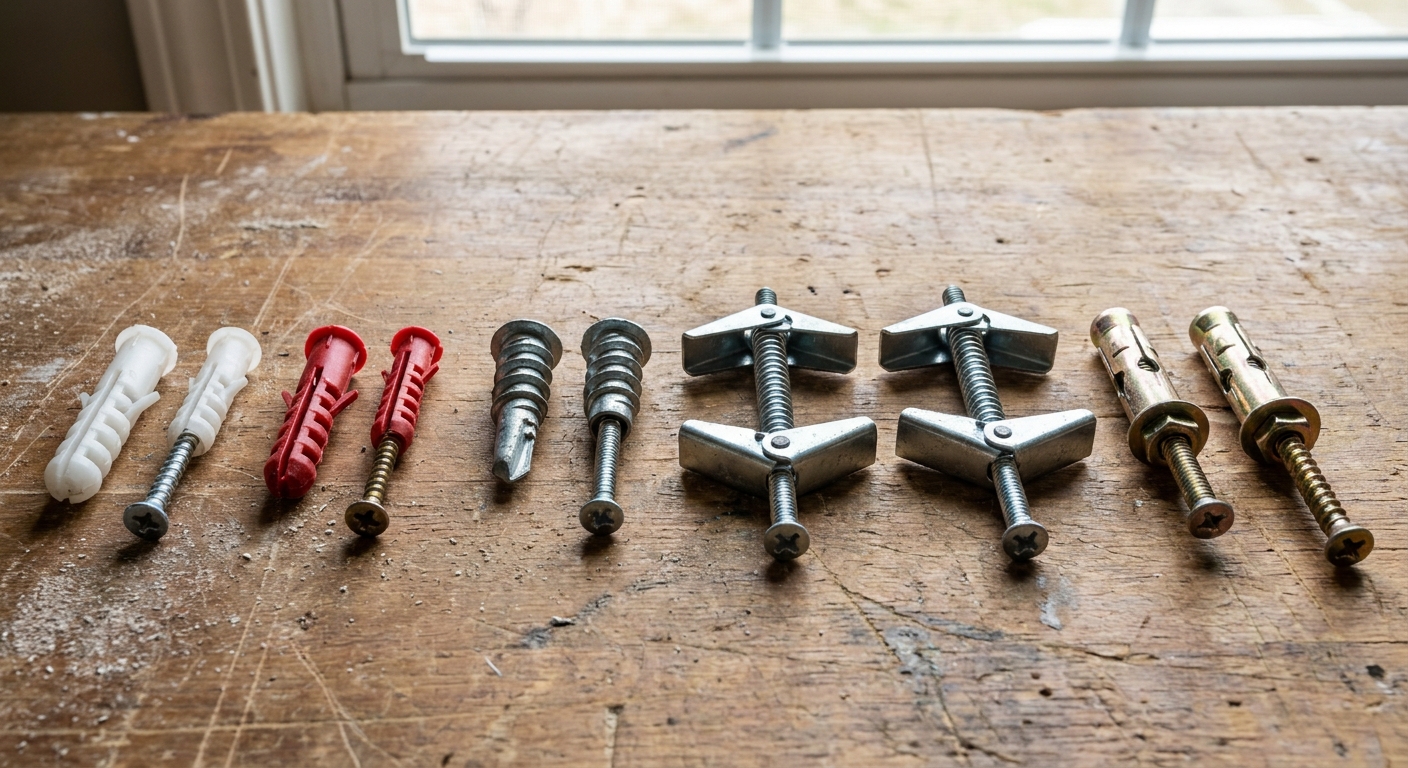
- Drywall anchors: A mixed pack (toggle style for heavier items, basic anchors for light stuff).
- Picture hanging kit: Hooks, wire, and a few common sizes.
- Painter’s tape: Clean lines, quick labels, and temporary holds.
- Sandpaper: A few grits (like 120 and 220) for patches and touch-ups.
- Spackle and a small sanding sponge: For nail holes and minor wall dings.
- Caulk (kitchen and bath): For tubs, sinks, and small gaps that invite water.
How to build your tool kit without overspending
Pick 5 tools to buy first
If you are starting from zero, grab these first: hammer, tape measure, screwdriver, adjustable wrench, and utility knife. That combo handles a surprising amount of homeowner life.
Buy better on the tools you touch the most
Put your money into the things you will use constantly: screwdriver, tape measure, utility knife, and pliers. A nicer version of these will feel better and last longer.
Used tools are fine, with two cautions
Estate sales and garage sales can be gold. Just avoid tools with cracked handles or wobbly joints. And skip anything rusty to the point that moving parts bind up.
Storage: where these tools should live
The best tool is the one you can find in 30 seconds. My recommendation for new homeowners is a small toolbox or open tote that stays inside the house, not out in a damp shed.
- Keep it central: A hall closet, laundry room shelf, or mudroom cabinet is perfect.
- Add a small zip pouch: For bits, hex keys, spare blades, wall anchors, and picture hooks.
- Label things: I am a carpenter, not a monster.
FAQ
Do I need a drill right away?
Not on day one. A drill is incredibly useful, but you can handle a lot with the hand tools above. If you do buy one, start with a basic 12V or 18V cordless drill/driver and a small set of bits.
What is the biggest mistake new homeowners make with tools?
Buying a giant kit and still not having the right tool when they need it. Start with the essentials, then add tools based on the projects you actually do.
What tools should I avoid cheaping out on?
Screwdrivers, tape measures, and cutting tools (utility knife and saw). Cheap versions slip, strip, and make simple jobs frustrating or unsafe.
Quick checklist you can screenshot
- 16 oz claw hammer
- 25 ft tape measure
- Torpedo level
- Screwdriver set or multi-bit driver
- 8 in adjustable wrench
- Slip-joint pliers
- Tongue-and-groove pliers
- Needle-nose pliers
- Utility knife + spare blades
- 2 to 3 in putty knife
- Stud finder
- Hex key set (metric + SAE)
- Small hand saw or pull saw
- Wire stripper and cutter
- Safety glasses + work gloves
Quick add-ons
- Non-contact voltage tester
- Outlet tester
- Drywall anchors
- Picture hanging kit
- Assorted screws
- Painter’s tape
- Sandpaper
- Spackle
If you want, tell me what kind of home you moved into (condo, older house, new build) and what projects are on your list. I can help you prioritize which of these to buy first so you are not spending money just to feel prepared.