
How to Replace a Central Air Conditioner Filter
Find your return filter slot, match the right size, read the airflow arrow, and seat the filter correctly. Plus a practical guide to MERV ratings and replacement timing.
Good grain. Great questions.
If your central air conditioner has a filter, replacing it is one of those small chores that pays you back in airflow, comfort, and a system that does not have to work quite so hard. I will keep this focused on the swap itself: finding the return, choosing the right filter, and installing it in the right direction.
Before you start
What you need
- A new filter in the correct size
- A flashlight (return slots can be in dim hallways, closets, or ceilings)
- Optional: a vacuum with a hose attachment for dusty edges
Quick safety note
For most filter swaps, you are not dealing directly with high voltage, but the safest habit is to turn the system Off at the thermostat (and turn the fan to Auto) before you pull the old filter. If your filter access is in or near equipment panels, or you are not sure whether you are opening an air handler or furnace cabinet, default to also shutting off power at the service switch or breaker. The goal is simple: no blower pulling dust, and no surprises near wiring.
Step 1: Find the filter
Most central systems keep the filter in one of these places:
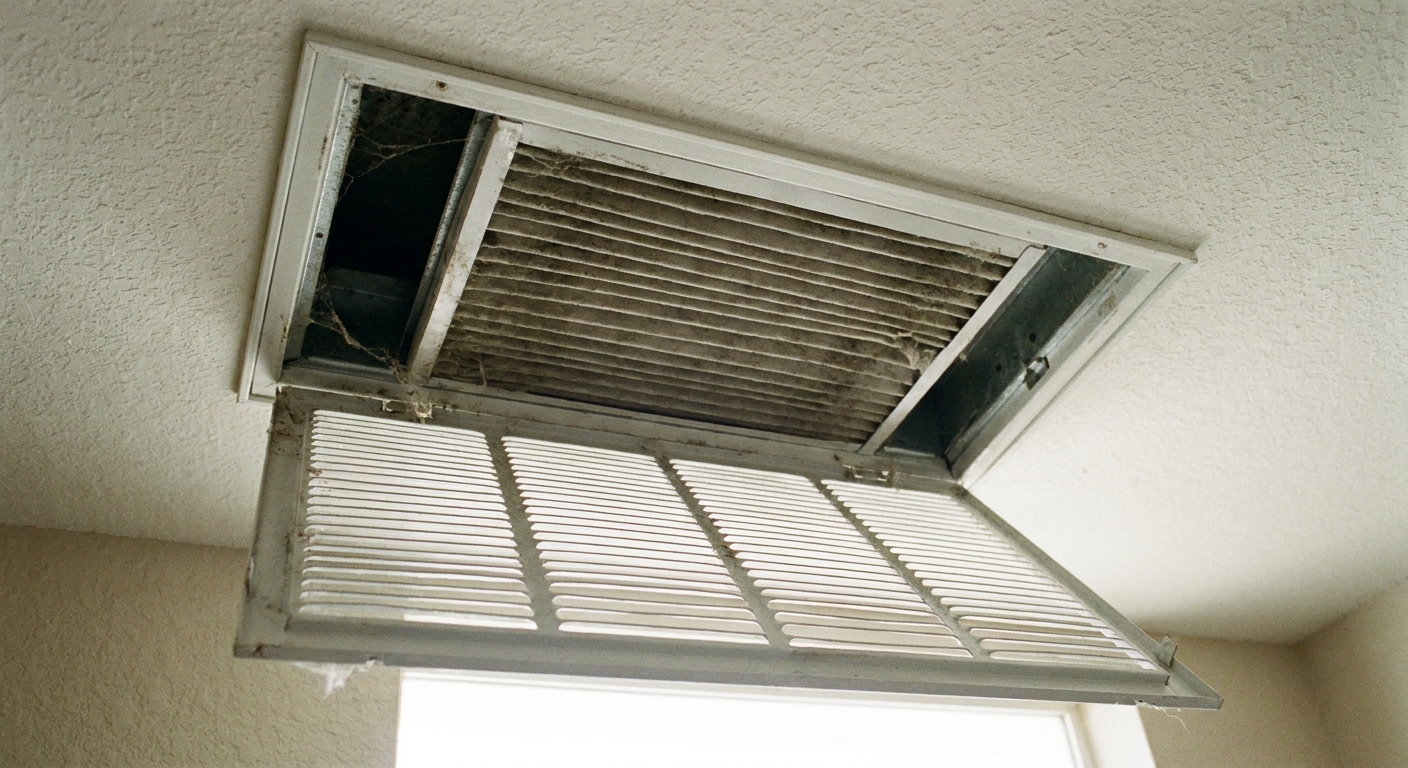
- Behind a return air grille in a hallway, living room, or ceiling. The grille door opens and the filter slides out.
- In a dedicated filter slot on the return duct near the furnace or air handler. This often looks like a narrow slot with a removable cover.
- Inside the air handler cabinet (less common for standard homeowner swaps, but it happens).
Clue to follow: look for the big return. Returns are the larger grilles that pull air into the system, not the smaller supply vents that blow air out.
Step 2: Pull the old filter cleanly
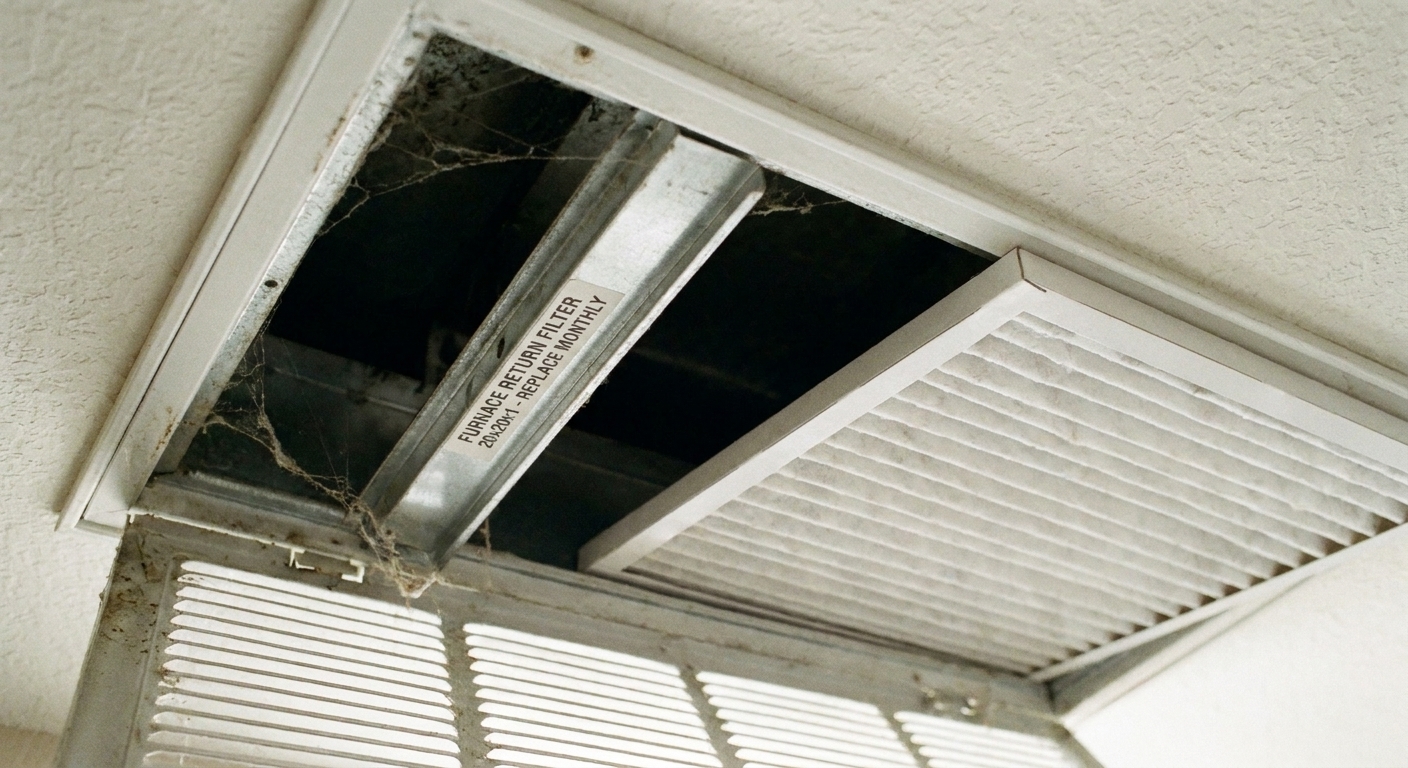
- Open the return grille door or remove the filter slot cover.
- Slide the filter out slowly. Keep it level so dust stays put.
- If the filter is very dirty, carry it straight to a trash bag.
If you see dust bunnies around the opening, vacuum the lip and nearby floor. Do not dig into the ductwork with tools. A quick clean at the edge is plenty for this job.
If there is no filter where you expected one, do not keep running the system while you guess. Take a minute to locate the actual filter slot (often near the furnace or air handler). If you cannot find it, it is worth calling an HVAC pro before you run the equipment unfiltered.
Step 3: Match the size
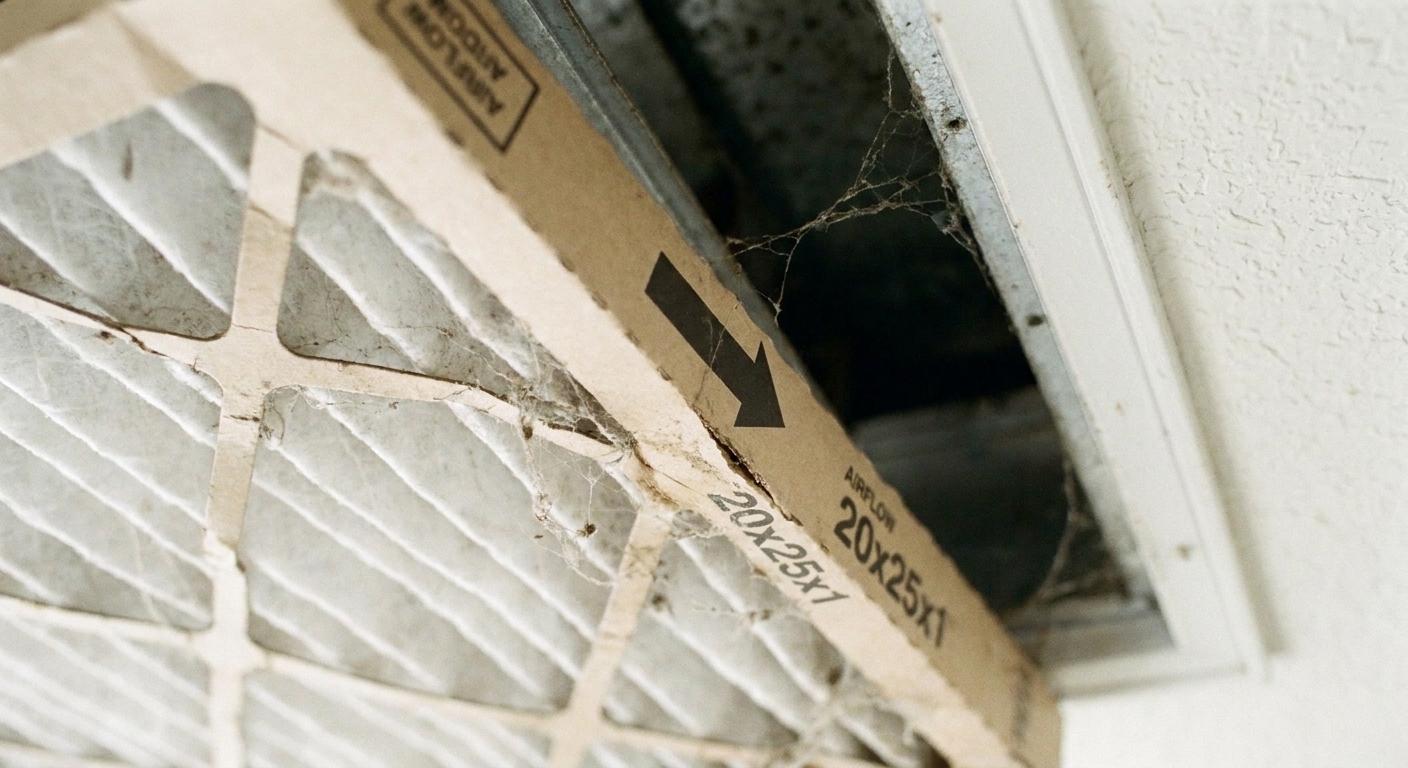
Filters are sized by width × height × thickness, usually printed on the filter frame. Common examples are 16×25×1 or 20×20×1.
A few sizing tips that save a second trip
- Read the old filter first. The size is typically printed on one side edge.
- Check the slot or grille label too. Many return grilles and filter racks have the size printed on the frame.
- Measure if the print is missing or questionable. Use a tape measure across the opening. Thickness matters too, especially if your system takes 4 inch or 5 inch media filters.
Important: A filter that is too small can let air slip around it, which is like wearing a scarf with a gap at the neck. A filter that is too big can buckle, tear, or keep the grille from closing.
One more detail that helps: many filters are sold in nominal sizes, and the actual dimensions are often slightly smaller (roughly 1/8 to 3/8 inch, depending on thickness and brand). That is normal. Match what your slot label calls for whenever possible.
Step 4: Follow the arrow
Every HVAC filter has an airflow direction arrow printed on the frame.
- The arrow should point toward the air handler or furnace (toward the blower).
- In plain terms: it points the direction the air is traveling as it gets sucked into the system.
Common scenarios
- Filter behind a return grille: the arrow points away from the room, toward the duct. In a wall return that usually means into the wall. In a ceiling return that often means up toward the attic or plenum.
- Filter at the furnace or air handler: the arrow points into the unit, toward the blower compartment.
Step 5: Seat it right
- Slide the new filter into the slot with the arrow pointing the correct direction.
- Make sure it sits squarely in the track or against the stops. No bowing, no twisting.
- Close and latch the grille door or reinstall the slot cover snugly.
If your return grille has a bit of play, that is normal. What you do not want is an obvious gap where the filter is not fully seated.
One more thing to watch for: some homes have more than one filter location. If you already have a filter at a return grille, do not add a second filter at the air handler unless your system was designed for it. Double-filtering can restrict airflow and make the equipment work harder.
Also, a quick heads-up: a small number of systems use an electronic air cleaner or a dedicated media cabinet. If what you see does not look like it is meant for a standard disposable filter, do not force a 1 inch pleated filter into the wrong spot.
MERV ratings, in plain English
MERV is a rating scale that tells you, broadly, how fine the filter is. Higher MERV usually means it catches smaller particles, but it can also reduce airflow if your system is not designed for it, especially with 1 inch filters.
A practical way to choose
- MERV 6 to 8: Good basic filtration for many homes and often the safest pick for airflow.
- MERV 9 to 11: A common sweet spot for better dust and pollen capture in many systems.
- MERV 12 to 13: Higher filtration, but can be restrictive in some setups. More likely to work well with thicker media filters and properly sized returns.
If you have allergies and want to step up filtration, do it thoughtfully: increase MERV one step, then pay attention to airflow at your vents and how quickly the filter loads up. If airflow seems noticeably weaker, drop back down.
How often to replace it
Replacement depends on filter thickness, MERV rating, how dusty your home is, and how hard the system runs. Use these ranges as a starting point, then adjust based on what you see.
- 1 inch filters: often every 30 to 90 days
- 4 to 5 inch media filters: often every 6 to 12 months
A simple rule that works
Check your filter monthly at first. Once you learn how quickly it loads up in your home, you can settle into a routine.
Use these real-world cues
- Replace sooner if you have pets, ongoing renovations, lots of outdoor dust, or you run the fan constantly.
- Replace sooner if the filter looks gray and matted and you cannot see much light through it when held up to a lamp.
- Replace later only if it still looks evenly clean and airflow feels normal.
My favorite low-effort habit: write the install month and year on the filter frame with a marker before you slide it in.
Common hiccups
No size printed
Measure the opening and match as closely as possible. If your slot, rack, or return grille has a size label, follow that first. Also remember that actual filter dimensions are often slightly smaller than the nominal size.
It will not slide in
- Check thickness first. A 2 inch will not magically become a 1 inch.
- Look for a track or ledge you missed. Some returns hold the filter in a specific channel.
- Do not crush it in. A bent filter can bypass air or shed fibers.
Two returns, two filters?
Possibly. Some homes have a filter at each return grille. Others have one main filter at the air handler. If you pull a filter out of a return grille, that return is filtered. If the grille is empty, do not assume it is missing. Check near the furnace or air handler for the central slot.
FAQ
Can I run my AC without a filter for a day?
It is not a good idea. Without a filter, dust can build up on the blower and indoor coil. If you are stuck waiting on a delivery, it is better to pick up a basic filter locally than to run unfiltered.
Do washable filters work?
Some people like them, but results vary. Many washable filters do a poorer job with fine dust unless they are high-quality and kept very clean, and they need to be fully dry before reinstalling. For simplicity, a disposable pleated filter is usually the easiest path.
Is the filter for AC or for heating?
In most central systems, it is the same filter for both. It filters the air moving through the blower, whether you are cooling or heating.
Wrap-up
Find the return, match the exact size, follow the airflow arrow toward the unit, and seat the filter cleanly in its track. Do those four things and you have done the job the right way, no guesswork required.