
Why Is My Window Air Conditioner Not Cooling?
If your window AC runs but the room stays warm, check the mode, filter, coils, air leaks, and sensor placement. Here’s a clear fix list, in order.
Good grain. Great questions.
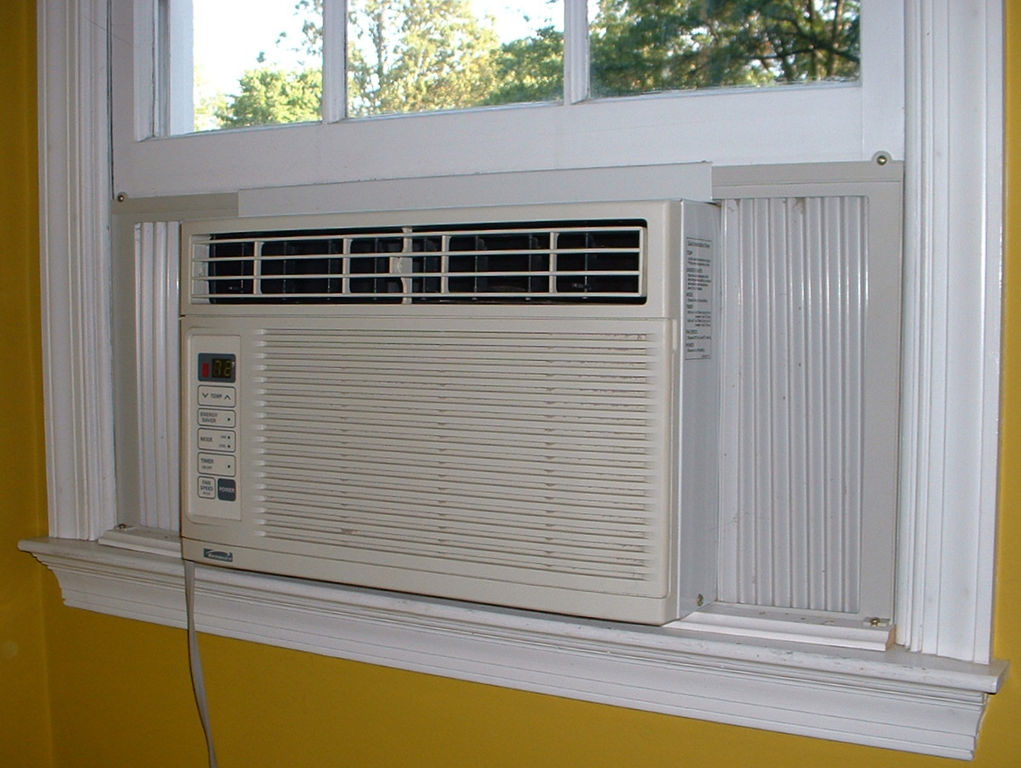
If your window air conditioner is humming away but the room still feels like a toasted marshmallow, you are not alone. Window and through-the-wall (sleeve) units can run with plenty of noise and very little cooling when something small is off: the wrong mode, a clogged filter, coils packed with lint, or a tiny gap that lets hot outside air march right back in.
Let’s sort it like a tidy bench. Start with the quick checks, then move into the deeper clean.
Before you troubleshoot
- Unplug the unit before removing covers or cleaning inside.
- Give it 10 to 15 minutes between changes (mode, temp, fan speed) to see results.
- Know what “normal” looks like: on a hot day, supply air from the front grille is often around 15 to 20°F cooler than the air going into the unit, but it varies with humidity, fan speed, and where you measure. For the most useful check, let it run in steady Cool for 10 to 15 minutes, then compare the air at the return (where it sucks room air in) to the supply (where it blows out).
Safety note: Do not open sealed refrigeration lines or “top off” refrigerant yourself. If a unit is low, it usually means a leak and that is a pro repair or replacement decision.
Fast checks that fix most “runs but not cooling” problems
1) Make sure it is actually in Cool mode
This one gets everyone at least once. Window units often have modes like Cool, Eco, Fan Only, Dry, and Auto.
- Set Mode to Cool (not Fan, not Dry).
- Set the temperature at least 5°F below the current room temp.
- Set Fan to High for troubleshooting. More airflow makes symptoms easier to read.
If the unit is in Eco and the fan keeps stopping, switch Eco off while testing. Eco can be fine later, but it can confuse the diagnosis.
2) Check the air filter right now
A clogged filter is the classic culprit. Air cannot cross the evaporator coil, so cooling gets weak and the coil can even ice over.
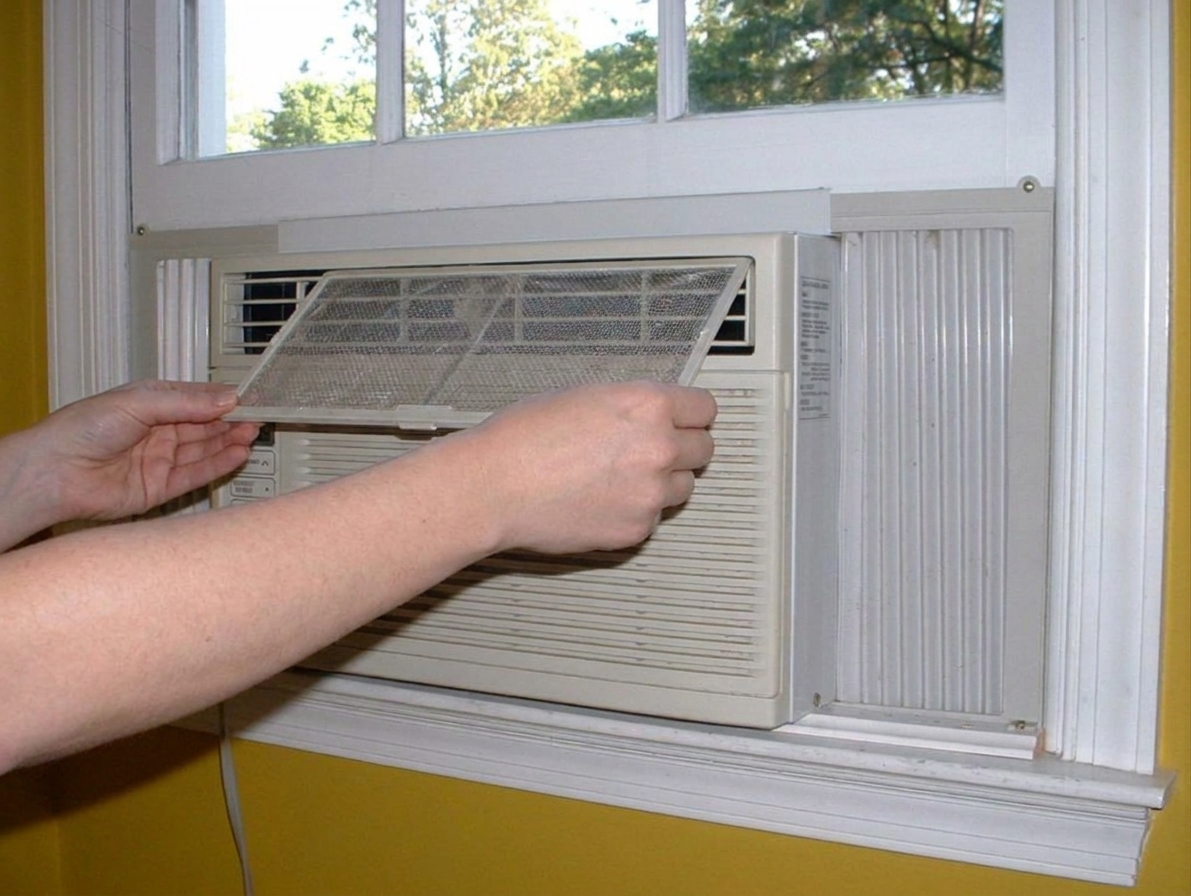
- Pull the front grille or filter door (varies by model).
- Remove the filter and hold it up to a light.
- If you cannot see light clearly, clean it.
Most window AC filters are washable mesh. Rinse with warm water and a little dish soap, let it dry fully, then reinstall.
3) Look for ice on the front coil area
If your unit runs but pushes weak, not-very-cold air, it might be frozen up. Signs include:
- Visible frost or ice behind the front grille
- Airflow that slowly gets weaker over time
- Water dripping inside after you shut it off (melting ice)
What to do: turn the unit to Fan Only for 30 to 60 minutes (or shut it off) to thaw. Then clean the filter, and if it keeps happening, move on to coil cleaning (see Step 8).
Common causes: restricted airflow (dirty filter, dirty coils, dirty blower wheel), running the unit when it is cool outside, and sometimes a sealed-system problem like low refrigerant. If you have repeated icing after cleaning and airflow checks, that is a good time to consider service.
4) Confirm the vent lever is closed
Many window units have a small fresh air vent lever or slider. If it is open, the unit can pull in hot, humid outdoor air while trying to cool. That is like trying to chill soup with the lid off.
- Find the vent control on the front panel.
- Set it to Closed or Recirculate.
5) Seal the “hot air sneaks” around the unit
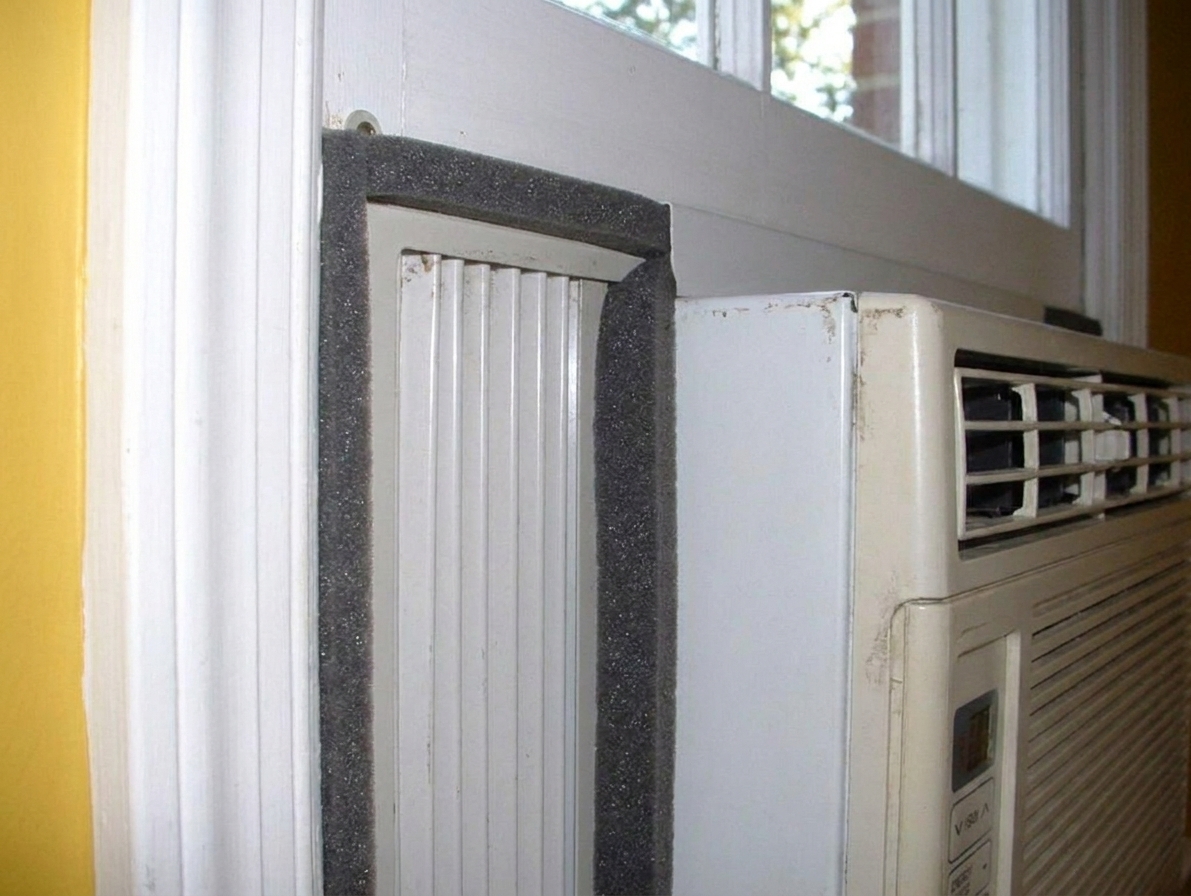
Window ACs are part appliance, part hole in your house. If the side curtains are loose or the sash gap is open, hot air will leak back in and you will feel like the AC is not doing anything.
- Press on the side accordion panels. If they flex and leak, reinforce with foam weatherstripping.
- Check the top sash contact. Add a strip of foam between sash and frame.
- Cover big gaps with rigid foam board cut to fit, then seal edges with removable tape.
Also check for hot air blowing into the room near the unit. That can mean the unit is not sitting snugly in the opening.
6) Make sure the back of the unit can breathe
The rear section dumps heat outside. If it is blocked, it cannot reject heat, and cooling falls off.
- Remove anything pressed against the outside grille.
- Trim back plants. Clear lint, cottonwood fluff, and leaves.
- If installed in a sleeve, confirm the exterior grille is not clogged.
Even a partial blockage can make the unit run constantly without keeping up.
7) Check the temp sensor and intake airflow
Many window units use a little temperature sensor (often a thermistor) near the front intake. If it gets knocked out of place, tucked behind the filter, or blocked by a curtain, the unit can misread the room and cool poorly or cycle oddly.
- Make sure curtains, furniture, or a bed are not blocking the front intake.
- If you can see a small sensor bulb or probe near the intake area, confirm it is not bent into the coil or buried in dust.
- Do a quick test: pull curtains back and clear at least a couple feet in front of the unit, then run in Cool on High for 10 to 15 minutes.
8) Skip extension cords and check power basics
Window ACs want solid voltage. Long or undersized extension cords can cause voltage drop, which can lead to weak performance, overheating, or nuisance trips.
- Plug the unit directly into a properly grounded outlet.
- Press the Reset button on the plug if it has test/reset controls.
- If breakers trip or the plug gets warm, stop and get the electrical side checked.
Deeper fixes: when the basics are good but cooling is still weak
9) Clean the evaporator and condenser coils
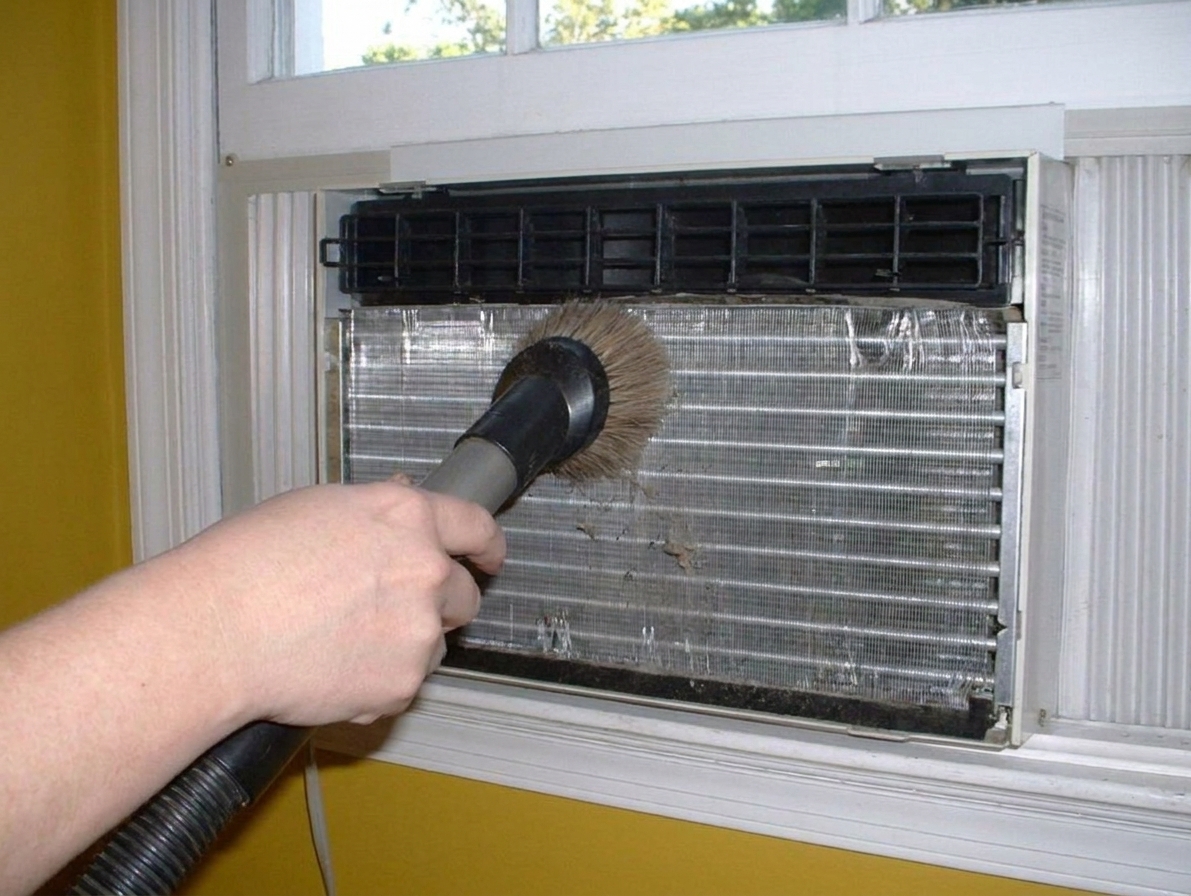
Here is the sneaky part: on many window units, the important coils are partially buried in the chassis. The front filter might be clean, but the coil fins behind it can be packed with fuzz. Same story outside on the condenser side.
You will need:
- Vacuum with a soft brush attachment
- Fin comb (optional)
- Coil cleaner safe for window units (optional)
- Soft brush and rags
- Screwdriver (often Phillips)
Steps (general approach):
- Unplug the unit.
- Remove the front cover and filter.
- Vacuum the evaporator coil area gently. Do not crush fins.
- If the outside coil is accessible, vacuum there too.
- If the coils are greasy or caked, use a cleaner labeled for HVAC coils and follow the label exactly. Avoid soaking electrical parts.
- Let everything dry before powering on.
If fins are bent, a fin comb can straighten them enough to improve airflow.
10) Clean the blower wheel (the hidden lint fan)
If your unit smells musty, rattles, or airflow is weak even with a clean filter, the blower wheel may be coated in grime. A dirty blower wheel cannot move air efficiently.
This can be a partial disassembly job on some models. If you are comfortable removing the outer shell, you can often access the wheel and clean it with a brush and mild soap solution. If not, this is a good point to call for service or decide whether replacement makes more sense.
11) Check the tilt and drainage
Many units are designed to sit with a slight tilt toward the outside so condensation drains properly. If it is level or tilted inward, water can pool and reduce performance, plus it can lead to odor and corrosion.
- From inside, the unit should be slightly higher than the outside.
- Do not over-tilt. Too much tilt can affect how it sits in the window and create air leaks.
12) Verify the outdoor fan is moving air
Some window units use a single motor that drives indoor and outdoor fans. If the outdoor fan is not moving enough air across the condenser, the unit will struggle to cool.
- With the unit running in Cool, look from outside and confirm strong airflow.
- If you hear the compressor but airflow outside is weak or the fan is not turning, shut it off.
A failing motor or capacitor is a repair job.
13) Through-the-wall and sleeve checks
Sleeve installs add a few extra ways for hot air to sneak back in or for the unit to overheat.
- Check the sleeve seal: make sure foam gaskets and trim are snug so outdoor air is not bypassing the unit and leaking indoors.
- Check the exterior grille: sleeves often have a separate rear grille that can clog with fluff and leaves.
- Confirm rear clearance: the outside side needs space to dump heat. If the sleeve is boxed in tight, performance drops.
When the issue is not really the air conditioner
The unit is too small for the room
BTU capacity matters. A unit that is undersized will run constantly and never catch up, especially with sun-facing windows, high ceilings, or a kitchen nearby.
- As a rough guide, many rooms land somewhere around 15 to 25 BTU per square foot as a starting range, then adjust for insulation, ceiling height, sun load, and occupants.
- If the unit used to cool fine and now does not, sizing is less likely. Dirt, airflow, sensor placement, and sealing are more likely.
The room is leaking hot air faster than you can cool it
Even a perfectly working window unit can lose the battle if:
- Doors are open constantly
- Attic heat is pouring down through an uninsulated ceiling
- Sun is blasting in without curtains
- There are big gaps around the AC, or the window does not close tightly
Quick win: close blinds on the sunny side and run a small fan to circulate air across the room.
Outdoor temperatures are extreme
When it is brutally hot outside, a window unit may maintain a comfortable temperature but not hit an icy setpoint. That is normal. Focus on steady improvement and humidity control.
When to stop DIY
- Warm air only even after cleaning filter and coils, with correct settings
- Compressor never starts (you may hear a click, then nothing)
- Repeated icing even with strong airflow, clean coils, and a correctly placed filter and sensor
- Electrical smells, scorching, sparking, or tripped breakers
- Oily residue on coils or lines, which can indicate a refrigerant leak
Window units are often replaced rather than repaired if they are older or if the sealed system is the issue. If yours is relatively new, service can be worth a look.
Quick troubleshooting checklist
- Set to Cool, temp lower than room, fan on High
- Close the fresh air vent
- Clean the filter
- Check for ice, thaw if needed
- Seal window gaps and side panels
- Clear the outside, improve rear airflow
- Confirm intake is clear and sensor is not blocked
- Clean evaporator and condenser coils
- Consider blower wheel cleaning if airflow is weak
FAQ
Why is my window AC running but not cooling at all?
The most common reasons are the wrong mode (Fan or Dry), a clogged filter, dirty coils, a fresh air vent left open, a blocked intake or misplaced sensor, or hot outside air leaking in around the unit. If all of those are handled and it still does not cool, the compressor may not be running or there may be a sealed system issue.
Should my window AC be dripping water outside?
A little dripping can be normal as humidity condenses. On some models, the unit slings water onto the condenser to improve efficiency, so you might see less dripping and that alone is not diagnostic. If it is dripping inside, check tilt and drainage, and make sure the unit is sealed and supported correctly.
Can low refrigerant cause weak cooling in a window unit?
Yes, but it is not the first thing to assume. Window units are sealed. If refrigerant is low, it usually means a leak. Start with airflow, sealing, and coil cleaning, then consider service or replacement if performance is still poor.
How often should I clean a window AC filter?
In heavy use, check it every two weeks and clean as needed. At minimum, clean monthly during the cooling season. Homes with pets, dusty streets, or wildfire smoke usually need more frequent cleaning.